
Well, They’re Wrong. When Feedback Contradicts what Leadership Believes
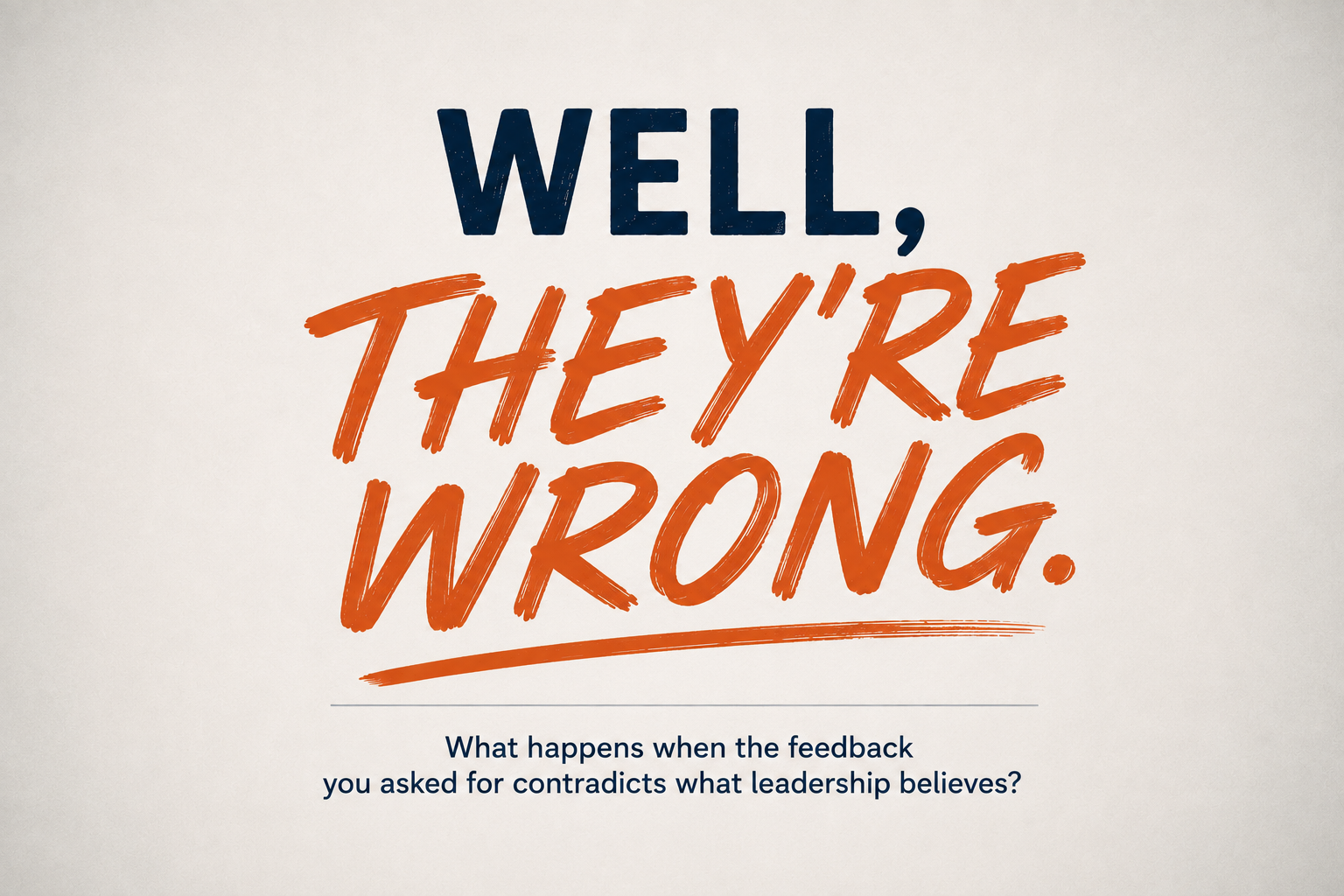
What happens when the feedback you asked for contradicts what leadership believes?
Years ago, I was sitting in a conference room with an executive team while an outside agency presented findings from employee and customer research. We were working through a larger brand project, and the agency interviewed customers and gathered confidential feedback from employees to understand how people actually experienced the organization.
At one point, the presenter summarized a consistent theme in the employee feedback. One of the executives, who had been standing at the back of the room listening, interrupted her, “Well, they’re wrong.”
The presenter paused and explained that there really wasn’t a right or wrong answer. She wasn’t making a recommendation or offering her opinion. She was reporting what employees had told her about their experience with the company.
He repeated the same response: “They're wrong.”
I had wanted independent research because I had concerns about the direction we were taking. At that point, though, the findings weren't about proving anyone right or wrong. They were information we needed to understand.
We were sitting in a room full of senior executives, and no one challenged him. No one defended the research or pointed out that whether we agreed with the feedback wasn't really the issue. The employees had told us how they experienced the organization, and that information deserved to be understood. Instead, the conversation moved on, and one person's refusal to consider the findings ultimately helped shape what happened next.
I still think about that exchange because it captured something I’ve seen in organizations more than once. We ask customers, employees or other stakeholders what they think, but sometimes what we really want is confirmation that they see the organization the same way we do.
When they don’t, the gap can be uncomfortable.
But that gap is often where the most useful information is.
Perception isn’t something leadership gets to declare
Leaders can decide what they want an organization to stand for. Marketing teams can develop positioning, messaging and brand standards intended to communicate that idea clearly. They can articulate the culture they want to create and the experience they want customers and employees to have. What they cannot do is simply declare that people are experiencing the organization that way.
If customers consistently describe your company differently from the way you describe it, that doesn’t automatically mean your customers misunderstand you. If employees describe the culture differently from leadership, telling them they are wrong doesn’t change their experience. In both cases, the difference between intention and perception is information.
That doesn’t mean every piece of feedback is equally accurate or useful. One angry customer does not necessarily represent the market, and one unhappy employee does not define an organizational culture. Good research requires context, patterns and judgment. But when consistent themes emerge, dismissing them because they conflict with what leadership believes wastes the very insight the research was designed to uncover.
Research is not a validation exercise
Organizations spend a great deal of time and money gathering information. We conduct customer interviews, employee surveys, market research, brand studies, focus groups and competitive analyses because we want to make better decisions. But research only has value if we are willing to learn something we didn’t already know.
If we go into research only willing to hear what we already believe, we aren’t really seeking understanding. We’re seeking validation. That distinction matters because strategy is built on what we believe to be true. If those assumptions are wrong, incomplete or outdated, the strategy built on top of them may be perfectly logical and still fail.
This is why I always say that understanding has to come before strategy. I know I repeat it, A LOT, but I continue to see what happens when organizations skip that step. Understanding isn’t simply gathering information. It requires being willing to discover that what we believe about our organization may not be what other people experience.
The value of uncomfortable feedback
There is a natural human tendency to defend what we know. Leaders have years of experience, institutional knowledge and responsibility for decisions that customers and employees may never see. Sometimes there are perfectly reasonable explanations for why an organization operates the way it does. But an explanation does not erase a perception.
An explanation doesn't erase a perception. If customers don't understand your value proposition, telling them they should understand it doesn't solve the problem. The same applies inside the organization. Employees may experience a process very differently from the way leadership intended it to work, just as the market may continue to associate your brand with something you've been trying to move away from. In each case, the perception itself is telling you something worth understanding.
The productive question is not, “How can they be wrong?”
It is, “What is creating this perception, and what does it tell us?”
What creates the perception may turn out to be a communication problem, an operational issue, a cultural disconnect or a gap between what the organization promises and what it delivers. Further investigation may even show that the feedback really is an outlier. That doesn't mean accepting every comment as absolute truth. It means remaining curious long enough to understand what's behind the feedback before deciding what it means or what to do about it.
Leadership requires enough confidence to be curious
I think this becomes particularly important for senior leaders because power changes the room. The more authority someone has, the easier it becomes for other people to stop questioning their assumptions. People learn when disagreement is welcome and when it isn’t. That makes curiosity a leadership discipline, not simply a personality trait.
When evidence contradicts what we believe, our instinct may be to question the evidence, defend what we know or dismiss the information altogether. But leadership requires resisting that instinct long enough to ask a different question: What are we missing?
That question creates room for examination. The research methodology may need to be challenged. There may be context the respondents didn’t have. The organization may have changed while the market’s perception hasn’t caught up. Or the people closest to the business may be seeing something leadership has stopped being able to see. You don’t know until you ask.
Understanding requires the possibility of being changed
If you ask people what they think, you have to be prepared for the possibility that their answer won’t match what you believe. That doesn’t require surrendering your judgment to a survey, a focus group or a handful of customer interviews. Leaders still have to evaluate the quality of the information, consider the broader context and decide what really matters. But there is a difference between exercising judgment and protecting an assumption.
The purpose of research is not to tell us that we were right all along. It is to reduce the distance between what we think is happening and what is actually happening, so we can make better decisions.
The research may confirm our instincts or tell us we need to adjust the strategy. It may also require the humility needed to acknowledge that the organization we intended to create is not exactly the organization other people are experiencing. That can be uncomfortable information.
It can also be some of the most valuable information a leader receives.