
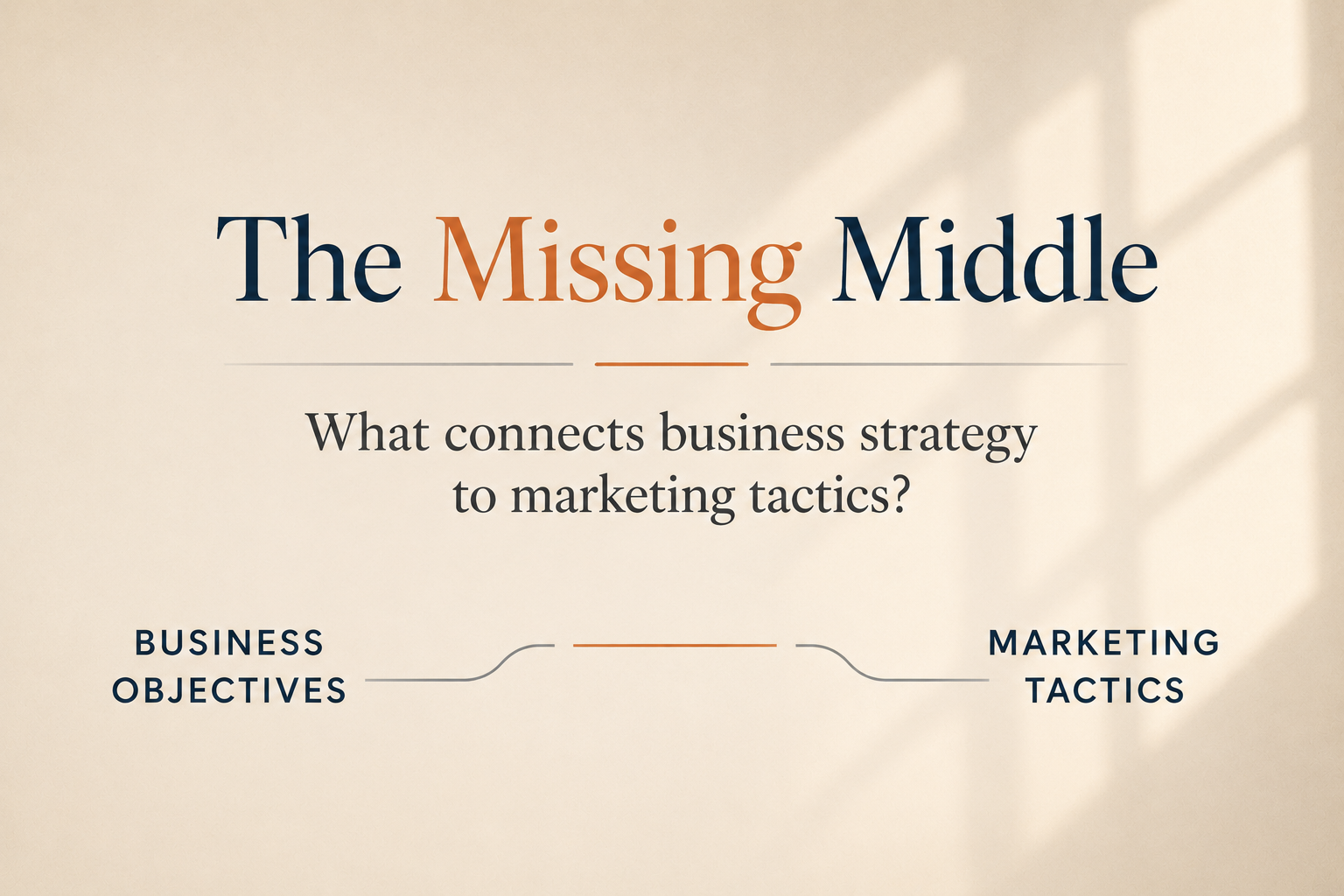
The Missing Middle: What Connects Business Strategy to Marketing Tactics?
What connects business strategy to marketing tactics?
A business goal tells you where the organization wants to go. Marketing tactics are the things you do to help get there. Marketing strategy is what connects the two—and that middle step gets skipped more often than you might think.
I’ve been in more than one conversation where leadership starts with a legitimate business objective. The organization needs to grow revenue, increase enrollment, enter a new market, improve retention or strengthen its competitive position.
Then, remarkably quickly, the conversation jumps to what Marketing needs to do about it. Maybe we need a new website. More digital advertising. An email campaign. More content. Better social media. Maybe we need AI.
Any one of those things could be part of the answer. But how did we get there?
That question matters because somewhere between the business objective and the marketing activity is a layer of thinking that organizations frequently skip. I think of it as the missing middle.
Business objective → Understanding → Marketing strategy → Marketing tactics
When that middle is missing, organizations can be very busy doing marketing without being particularly clear about why they are doing it.
A business objective is not a marketing strategy
“We need to grow revenue by 15 percent” is a business objective.
It tells us what the organization wants to accomplish, but it doesn’t tell us where that growth should come from, which customers represent the best opportunity, what might prevent them from buying, how the organization is positioned against competitors or what Marketing should do differently to influence the outcome. Those questions begin to move us toward strategy.
The same is true when the objective is increasing enrollment, improving retention, entering a new market or growing an existing customer segment. Marketing cannot translate any of those objectives into meaningful action without first understanding what’s happening within the organization and in the market.
Yet tactics are tempting because they are tangible. You can redesign a website. Launch an advertising campaign. Send an email. Create content. Buy technology. Those activities create visible signs of progress.
Strategy is less visible. It requires asking questions, examining assumptions and sometimes slowing down long enough to determine whether the problem everyone is trying to solve is actually the problem.
Understanding still has to come first
If you’ve read more than one thing I’ve written, you’re probably thinking, “Here she goes again.” Yes, I’m going to say it : understanding has to come before strategy. I know I sound like a broken record, but this is one hill I’m willing to die on. I continue to see what happens when organizations skip that step, and no amount of brilliant strategy—or impressive execution—can compensate for starting with the wrong understanding of the problem.
I once worked with an organization where the initial concern was that Marketing simply wasn’t getting enough done. There were plenty of requests for communications, campaigns, website changes and other marketing activity, so the apparent solution was straightforward: improve execution and produce more.
But once I started asking questions and talking with the people involved, a different picture emerged. Marketing was producing work. The larger challenges involved how information moved through the organization, who owned content, how decisions and approvals were made, and how different departments communicated—or didn’t communicate—with one another.
Producing more marketing wouldn’t have solved those problems. In fact, it probably would have created more activity inside a system that was already struggling to work together.
The request sounded tactical. The problem wasn’t.
This is also why I don’t consider asking questions before recommending a tactic to be slowing things down. Before I spend your money on digital advertising—or anything else—I want to understand what we’re trying to accomplish and what’s preventing it from happening today. That isn’t slowing down execution. It’s what makes effective execution possible.
Understanding belongs between the business objective and the strategy.
Before deciding what Marketing should do, we need to understand customers, competitors, internal capabilities, organizational constraints and what is actually standing between where the business is today and where leadership wants it to go.
Marketing strategy is the connective tissue
Marketing strategy translates a business objective into a set of choices about where Marketing can have the greatest impact.
If the business wants growth, for example, strategy helps determine whether the better opportunity is acquiring new customers, increasing business with existing customers, entering a new segment, strengthening retention or improving conversion. Those are very different growth problems, and they shouldn’t automatically lead to the same marketing plan.
Strategy also forces choices about audience, positioning, value proposition, messaging, customer experience, channels, resources and measurement. It also helps determine what not to do.
That can be difficult because organizations rarely suffer from a shortage of marketing ideas. There is always another platform to join, campaign to launch, technology to buy or tactic someone saw a competitor using.
A good strategy gives you a reason to say yes to some of those things and no to others.
Without it, marketing can become a collection of activities rather than a coordinated effort tied to the business.
The tactic may be right—and still be the wrong place to start
None of this means websites, email, digital advertising, social media or AI are bad ideas. The problem is deciding they are the answer before we have done enough work to understand the question.
A website redesign makes sense if the current digital experience is preventing customers from understanding the company, finding what they need or taking the next step. It makes considerably less sense if the real problem is an unclear value proposition that will simply be transferred into a prettier website.
The same principle applies to advertising. More advertising can increase visibility, but that won’t solve weak positioning. If prospective customers are already reaching your website and leaving because they don’t understand what you do or why it matters to them, buying more traffic may simply mean paying to introduce more people to the existing problem.
Generating more leads may sound like the answer, but not if Sales and Marketing don’t even agree on what constitutes a qualified opportunity. And I’ve seen plenty of organizations invest in better technology only to discover that technology can’t fix a process no one has clearly defined.
The tactic itself may work exactly as designed and still fail to solve the business problem.
That is one reason marketing performance can be so difficult to evaluate. When a tactic underperforms, the immediate assumption is often that the tactic failed. Sometimes it did. But sometimes the organization chose the wrong tactic because it never developed the strategy that should have guided the choice in the first place.
Good strategy doesn’t prevent action. It establishes the right sequence for it.
The missing middle is an organizational problem
I’ve seen organizations where executives could speak confidently about business goals and marketing teams could speak fluently about campaigns, channels and deliverables, yet the connection between those conversations remained surprisingly weak. But the missing middle isn’t Marketing’s problem alone.
Marketing strategy works best when leadership, Sales, Product, Operations, Finance and other relevant functions contribute what they know about the business. Marketing brings customer understanding, market perspective and expertise in how to influence behavior, but it cannot develop a meaningful strategy in a vacuum.
That’s why simply handing Marketing a business objective and asking for a list of tactics doesn’t work. Leadership can define where the organization needs to go, but Marketing still needs the context and understanding required to determine how it can help get there. Building that strategy requires input and engagement from the relevant stakeholders across the organization, each contributing what they know about the business.
If that conversation doesn’t happen, the missing middle doesn’t disappear. It gets filled with assumptions.
Start With the Right Questions
There will always be pressure to move quickly, and AI will only make it easier to move from a business objective to a polished list of recommended tactics in seconds. That makes the discipline of understanding even more important.
Before asking whether you need a new website, another campaign, more digital advertising or the latest technology, spend some time on the questions that connect those activities to the business:
- What are we actually trying to change?
- What is preventing that from happening today?
- Which customers or audiences matter most?
- What do they believe about us now?
- Where do we have an advantage?
- What internal realities could prevent us from delivering what we’re promising?
- How will we know whether Marketing influenced the business outcome we started with?
You may still end up deciding that you need the website, the advertising or the email campaign.
But now you know why.
That’s the difference between executing marketing tactics and building a marketing strategy that actually moves the business.