
Can AI replace an entire marketing department?
Can AI replace an entire marketing department?
No. But it can dramatically change what a marketing department should spend its time doing.
AI can do an extraordinary amount of work that once required significant human time. It can research a market, summarize hundreds of pages of information, analyze data, identify patterns, organize notes, draft content and help turn a pile of disconnected ideas into something useful.
I use it every day for those very things.
So, when executives look at those capabilities and ask whether AI could allow them to operate with fewer people, I don't think that's an unreasonable question. Leaders should be looking for ways to improve productivity, reduce unnecessary costs and use technology to help their organizations work more efficiently.
BUT... I think there's a more important question to ask before deciding which positions, or departments, AI can replace: “What work are you automating, and what organizational capability might you accidentally eliminate along with it?”
That distinction matters.
AI Can Automate Marketing Tasks.
It Can't Replace Marketing Expertise.
Marketing departments produce websites, emails, presentations, social media posts, advertising, research, reports, sales materials, videos and content. AI can already help produce many of those things faster, and its capabilities will continue to improve.
But producing marketing materials is not the same as having marketing expertise.
Marketing requires understanding why customers buy, what prevents them from buying, how competitors are positioned, where the organization has an advantage and whether customers perceive that as an advantage. It requires understanding the business well enough to recognize when the problem everyone is trying to solve maybe isn't actually the real problem.
If a CEO looks primarily at the output of a marketing department, AI can make replacing much of that work seem pretty straightforward. If the CEO understands the organizational capability behind that output, the calculation becomes very different.
AI can dramatically increase an individual's productivity, but that doesn't mean one person using AI suddenly possesses the collective expertise of an entire marketing function. AI can help you do more with what you know. The greater risk is what you don't know to ask, challenge or provide as context in the first place.
AI Doesn't Eliminate the Need for Judgment
AI can absolutely SUPPORT judgment. It can surface patterns, compare options, flag inconsistencies, model scenarios and even make recommendations based on criteria we've given it. But that's not the same as judgment. Judgment requires deciding what actually matters in context, including information that may be incomplete, contradictory, emotional, political, experiential or simply was never entered into the system. It also involves something we don't talk about enough: accepting accountability for the decision.
I spend a lot of time questioning AI, asking for clarification, challenging assumptions and pointing out context it couldn't possibly know unless I provided it. And sometimes my response is a quick, "Nope. That's not it."
A recommendation can follow accepted best practices and still be completely wrong for a particular company and a message can be beautifully written, but miss what customers actually care about. I’ve seen a strategy make perfect sense on paper and fail because the organization doesn't have the people, technology, budget or organizational commitment to execute it.
Imagine asking AI to develop your company's marketing strategy. You provide your products, target audiences, revenue goals, competitors and budget. Within minutes, you could have a remarkably polished strategy sitting in front of you.
But what if your largest customer is threatening to leave, Sales doesn't trust the leads Marketing sends them, the CRM data is unreliable, or your customers describe your value completely differently from the way your leadership team does? These aren't unusual circumstances or extreme examples. They're the kinds of realities organizations have to navigate every day.
Now the answer changes.
That's the part of business that doesn't always fit neatly in a spreadsheet, database or AI prompt. Organizations have histories, customers have emotions, teams have relationships and leaders have competing priorities, all while markets continue to behave unpredictably.
And there's another issue that's equally important: the person using AI needs enough expertise to evaluate what comes back. AI can generate a marketing strategy in seconds. That doesn't mean the strategy is right. Without marketing expertise, customer knowledge, organizational context or enough experience to challenge the recommendations, an output can look impressively complete while still being fundamentally generic and wrong for the company.
AI only knows the context you give it. Someone still has to be able to look at the answer and say, "That's technically reasonable, but it doesn't fit this organization." Or, "We're solving the wrong problem." Or simply, "No, that's not what I mean."
AI can produce an answer. The person using it still has to know whether the answer is any good.
Think of AI as a Table Full of Puzzle Pieces
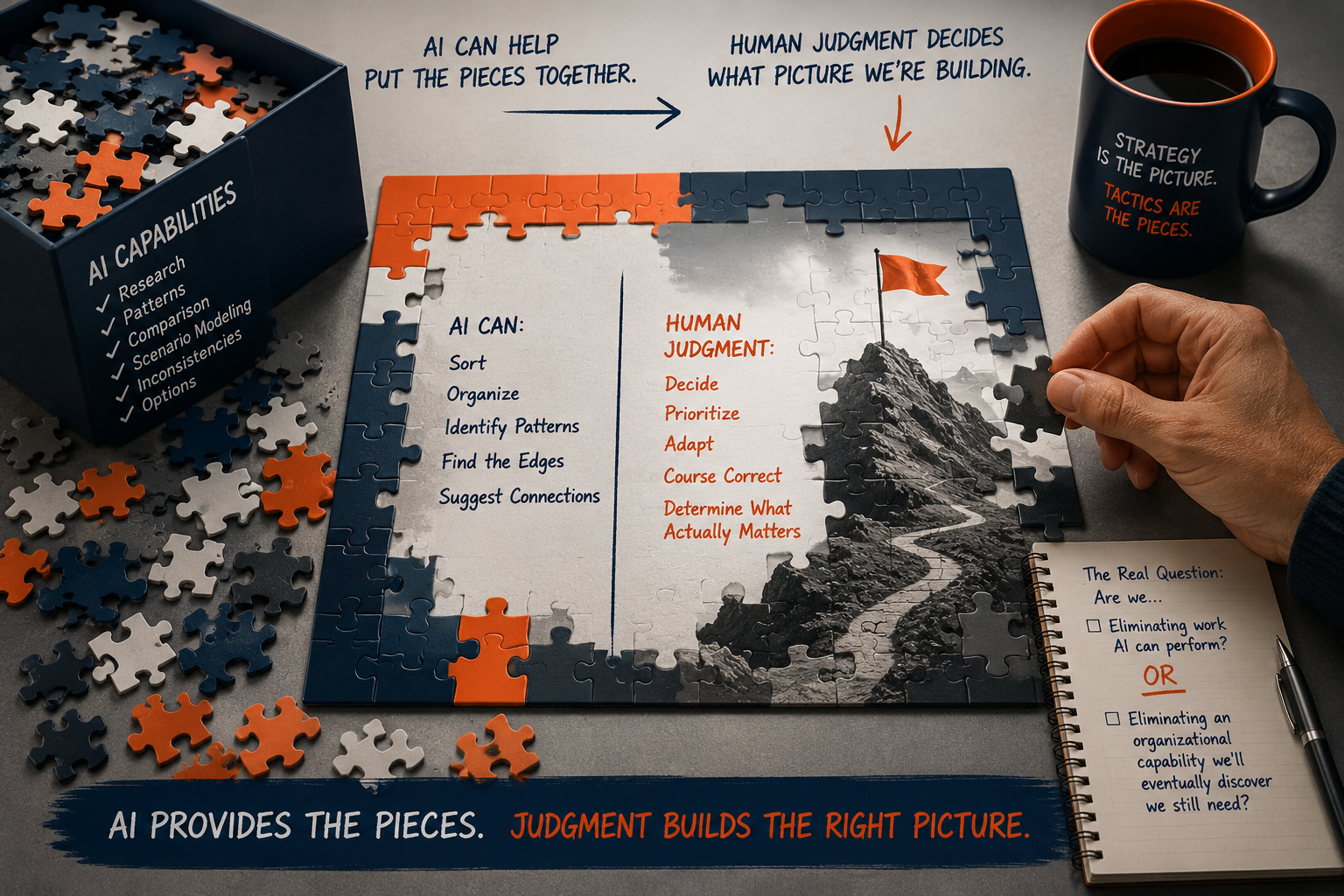
One of the best ways I've found to describe my own use of AI is to think about working on a puzzle. I tend to dump the pieces onto the table. Some are research. Others are experiences, conversations, customer insights, half-developed ideas, things I've observed over twenty-plus years and thoughts that may not initially seem related.
AI is very good at helping me sort through them. It can group pieces that appear to belong together, identify patterns I haven't noticed and help me find the edges of the puzzle so the picture becomes easier to see. Sometimes it even notices a piece I've been staring at and asks, "Doesn't this belong over here?"
That's incredibly valuable.
But AI doesn't automatically know what picture I'm trying to build. Sometimes, once the pieces start coming together, I realize the picture isn't what I thought it was going to be either. That's where the interaction becomes useful. AI isn't doing my thinking for me. It's structuring my thoughts and giving my thinking something to work with.
Research, Synthesis and Discernment Are Different Activities
That puzzle analogy helped me recognize an important distinction in how we use AI.
- Research answers: What is known? AI can dramatically accelerate our ability to gather information and understand a business landscape.
- Synthesis answers: What belongs together? AI is remarkably good at finding connections, organizing information and helping us recognize patterns.
- Discernment asks: What actually matters?
- That's where experience becomes important. A leader has to determine which information deserves attention, which pattern is meaningful, which recommendation fits the organization and which technically correct answer should be ignored.
If AI can perform the research and produce the first draft, it's tempting to conclude that the person who used to perform those tasks is no longer necessary. But perhaps we've been looking at the wrong part of their job. Maybe the real value wasn't typing the words. It was knowing what needed to be said.
The Real Opportunity Is Leverage
I don't think we should protect every task people currently perform simply because humans have always performed it. Some work SHOULD change. For example, repetitive work should disappear where it makes sense, and some processes may require fewer people than they did five years ago. But, that's what technology has always done.
There's a significant difference between eliminating unnecessary work and eliminating the organizational knowledge, customer understanding and professional judgment that made the work valuable in the first place.
If AI can handle more of the production, perhaps experienced marketers should spend less time producing and more time understanding customers, evaluating opportunities, challenging assumptions, working with Sales, interpreting data and helping leadership decide where the organization should go next.
That's not protecting Marketing from AI. It's using AI to move Marketing toward higher-value work.
To be honest, there are times when working with AI actually takes me longer than simply doing the work myself. If I need a summary, AI saves me tremendous time. But if I'm developing an idea, I may go back and forth repeatedly, challenging language, questioning conclusions, adding context and occasionally discovering that something I thought was a minor observation is actually the most important idea in the entire piece.
The first draft gets faster, but the thinking gets deeper. That's the opportunity I see in AI: not replacing the expertise we've spent decades developing, but giving that expertise greater leverage. So yes, executives should absolutely be asking where AI can improve productivity and reduce costs.
But before eliminating a role, a team or an entire department because AI can perform many of its visible tasks, ask one more question: "Are we eliminating work that AI can perform, or are we eliminating an organizational capability we'll eventually discover we still need?"
Those are very different decisions. And knowing the difference is exactly why human judgment matters MORE, not less, in the age of AI.